

What Are the Top AC Drive Types in 2026?
In 2026, choosing an ac drive is less about chasing the newest label and more about matching control to the job. A pump in a quiet water room has different needs from a conveyor that starts under a full load. The right choice can improve speed control, reduce mechanical stress, and support more efficient operation. The wrong one may add cost and complexity without solving the real problem.
Electric motor drives scholar R. Krishnan’s work offers a useful principle: drive selection should account for the motor, the load, and the required control. That is a practical lens for comparing variable-frequency drives, vector-control drives, direct-torque-control systems, and medium-voltage options. Each type has trade-offs. Some suit steady fan and pump duty; others provide tighter torque response for demanding machinery. Details matter.
This guide examines the leading ac drive types expected to matter in 2026, where each fits, and what buyers should check before specifying one. It considers control performance, motor compatibility, operating conditions, and installation needs. A drive’s brochure rating is not the whole story. Real results depend on commissioning and the application. And rankings can mislead: “top” varies by industry, not just technology.
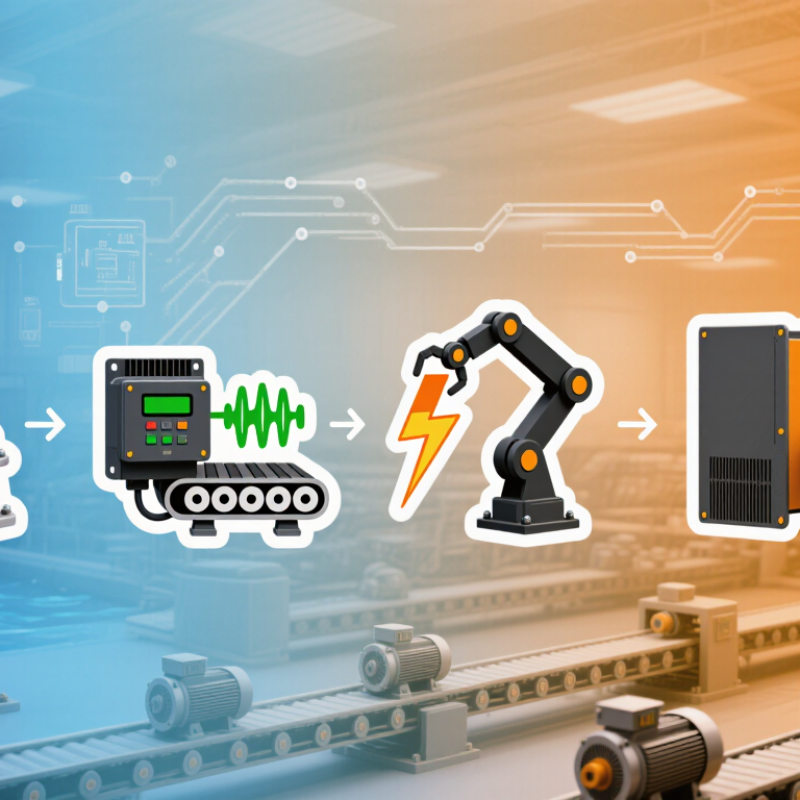
How AC Drives Control the Speed and Torque of Electric Motors
An AC drive controls motor speed by changing the frequency of the power supplied to the motor. It adjusts voltage as well, helping maintain a suitable magnetic field across the operating range. A pump ramping up slowly can reduce pipe jolts and sudden starting current. Small changes matter.
Common drive control approaches include scalar V/Hz, sensorless vector control, and encoder-based vector control. Scalar control suits many fans and pumps with steady loads. Vector control estimates motor behavior to regulate speed and torque more precisely, especially at low speeds. With an encoder, the drive receives direct speed feedback. Some drives also use direct torque control to respond quickly to changing load demands. These methods are not interchangeable in every application.
The load should guide the choice. A conveyor carrying a heavy box may need strong starting torque, while a ventilation fan usually needs smooth speed adjustment. Correct motor data and drive settings matter; a mismatch can cause poor control or overheating. Not always. Feedback devices add accuracy, but also wiring and setup work. In practice, the simplest option that meets the machine’s torque and speed needs is often the easier one to maintain.
| AC Drive Type | Classification | How It Controls Speed and Torque | Typical Strengths | Common Applications | Important Considerations |
|---|---|---|---|---|---|
| V/f (Scalar) Drive | Control method | Varies the output frequency and voltage together to maintain an approximately suitable volts-per-hertz ratio. Motor speed follows the commanded frequency; torque is regulated less directly than with vector methods. | Simple setup, broad motor compatibility, and effective operation for many steady or gradually changing loads. | Fans, pumps, blowers, and basic conveyors. | Less precise at very low speed and during rapid load changes; performance depends on motor and drive settings. |
| Sensorless Vector Drive | Control method | Uses a motor model and measured electrical quantities to estimate motor behavior and regulate flux and torque-producing current without a shaft encoder. | Improved torque response and speed regulation compared with basic V/f control, without an external speed sensor. | Conveyors, mixers, compressors, and general-purpose machinery. | Low-speed performance and estimation accuracy vary with drive design, motor data, and load conditions. |
| Encoder-Based Vector Drive | Control method with feedback | Uses encoder feedback for measured shaft speed or position and independently regulates motor flux and torque-producing current. | Precise speed regulation, strong dynamic torque control, and support for applications requiring controlled low-speed operation. | Hoists, elevators, winders, and precision material handling. | Requires compatible feedback hardware, wiring, setup, and maintenance; performance is system-dependent. |
| Direct Torque Control (DTC) | Control method | Estimates motor flux and torque from electrical measurements and selects inverter switching states to control them directly; implementation details differ by drive. | Fast torque response and strong dynamic performance in applications with changing loads. | Dynamic industrial machinery, test systems, and demanding drive applications. | Torque ripple, switching behavior, and low-speed performance depend on the specific control implementation and system setup. |
| Voltage-Source Inverter (VSI) Drive | Power-conversion topology | A DC-link voltage feeds an inverter that synthesizes variable-frequency, variable-voltage AC, commonly using pulse-width modulation. It can use V/f, vector, or other control methods. | Widely used across low- and medium-voltage systems, with multiple available control strategies and configurations. | Industrial pumps, fans, compressors, conveyors, and many other motor-driven loads. | Output switching can create motor-side electrical stress and electromagnetic interference; installation may require suitable cabling, grounding, or filtering. |
| Multilevel VSI Drive | VSI topology, commonly used at medium voltage or higher power | Uses multiple voltage levels to build the AC output waveform; the exact circuit arrangement varies. Speed and torque control depend on the selected control method. | Can provide higher-voltage output with stepped waveforms and may reduce output harmonic content compared with a two-level inverter, depending on design. | Medium-voltage pumps, fans, compressors, and large industrial motors. | Circuit complexity, installation requirements, and maintenance needs depend on topology and system rating. |
| Current-Source Inverter (CSI) Drive | Power-conversion topology | Uses a controlled DC-link current and an inverter to supply variable-frequency AC to the motor; speed and torque behavior depends on the control system and motor application. | An established option for certain high-power industrial systems and applications with suitable motor and load characteristics. | Selected large industrial drives, including some high-power process applications. | Generally less common than VSI solutions in many modern low-voltage applications; suitability depends on system requirements and motor compatibility. |
| Note: V/f, vector control, and DTC describe control methods; VSI and CSI describe power-conversion topologies. These categories can overlap—for example, a VSI drive can use V/f or vector control. Actual speed and torque performance depends on the motor, drive rating, feedback, settings, and application. | |||||
Related Posts
-
Top 10 Types of Variable Frequency Drives
-
What Is a VFD Variable Frequency Drive and How Does It Work?
-
How to Choose the Best AC Motor Speed Controller for Your Needs?
-
2026 Top Variable Frequency Drive Types?
-
How to Choose the Right VFD Variable Frequency Drive?
-
Why Choose an AC Motor Speed Controller?